Back in January, I wanted to understand how the spaces around us affect how we feel, move, and connect. To explore this, I’m starting a mini-series called Field Notes: Observing Design in Lived Spaces. I’ll visit real places with real people, noticing how these spaces are used, who may feel welcome, who might not, and who benefits from the design. I’ll also bring my own perspective and interest in understanding children, families, and their communities of support to these observations.
Volume 1: Restaurants as Social Gathering Spots
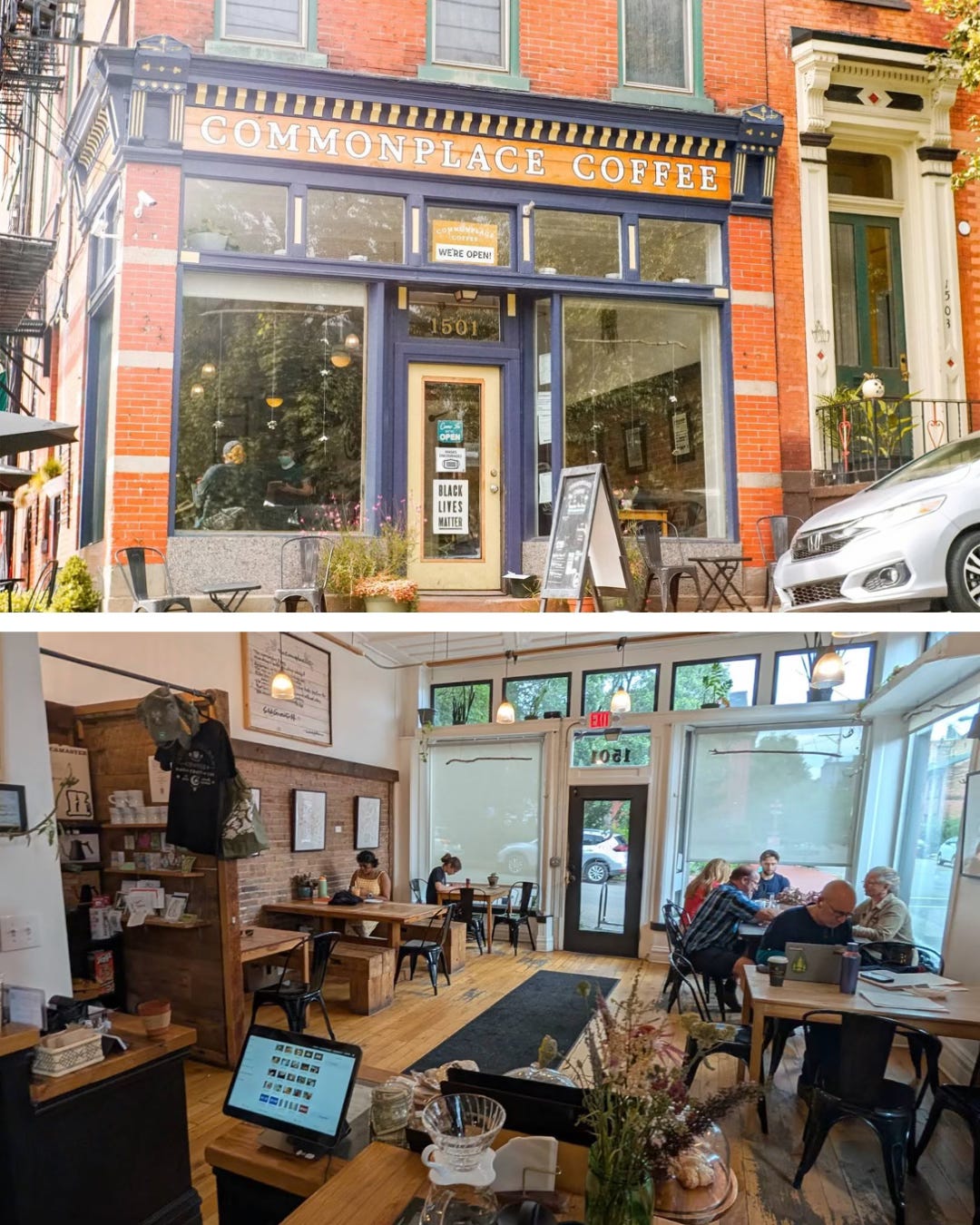
During a trip to Pittsburgh, PA, we stopped by Commonplace Coffee in the historic Mexican Street Wars neighborhood. I loved the old buildings and the feel of the area. Hayden and I even imagined what it would be like to live there. Commonplace Coffee is a local spot with several locations in Pennsylvania. Right away, I noticed how busy it was. The line was almost out the door. When we ordered, the barista let us know that seating was communal.
SOCIAL CONTRACT!!! Ding ding ding! To sit here and enjoy your coffee, you must agree to the coffee shop’s social contract. I love places where no one feels like a stranger. I first thought about this idea at a social impact leaders gathering, and since then, I’ve looked for moments that help break the usual awkwardness when we share space with others. We had to choose where to sit, and I had that first-day-of-school feeling. I walked over to a big table with benches and asked a man if we could join him. He was working on his laptop, so I made a little small talk about our 12-hour drive from Atlanta. He told us we picked a bad time to visit because of the cold, and then I let him get back to his work.
- Where does my body relax? Despite the space feeling cozy because of the historic features, I surprisingly felt okay after we found a place to land, and this aspect lended itself well to the mutual understanding that yes, this space is tight, yes we have to be intentional about making room for others who are not in our immediate circle, and yes, we all enter this space with a shared agreement to do so. This stripped away a lot of the discomfort of being close and actually made it okay to do so. Still, I can imagine this setup might not work for everyone. For example, people who are introverted, neurodivergent, or who experience social anxiety might still feel uneasy or overwhelmed by the closeness and the need to share tables with strangers. Even in welcoming spaces, not everyone automatically feels at ease, and some may need more options to create a sense of comfort.
- Who is this space designed for? An added social contract removes the barrier to entry. As a patron, you can either grab a spot or leave. Conveniently, there was a neighborhood park across the street, open to the public, with tons of outdoor seating.
- Who must work harder to feel safe, seen, or comfortable here? I can see how this kind of social contract might keep someone who likes their own company from staying long. A pair of headphones could help signal that you want to be left alone.
- What behaviors does this space quietly encourage or discourage? This space encouraged neighbors to simply talk and challenged “outsiders” to get to know a neighbor.
- Gentle Interventions: Along with the menu posted outside the door, I would suggest a clear sign indicating that this is a place where we share tables with people we don’t know before you enter the space. That way, guests know what to expect and can decide if the environment matches their comfort level. Another idea is to have friendly staff or hosts greet people at busy times, offer seating suggestions, or even introduce guests to tablemates, making those first moments less awkward. Table cards or small signs could be placed on communal tables with a simple visual cue or message that says “Happy to Share!” or “Join Me!” to help signal openness and set the tone for positive connections. For those who need more privacy or feel uneasy, offering a few quieter corners or single tables could help everyone feel welcome. Little touches like these show that inclusion is intentional, not just hoped for.
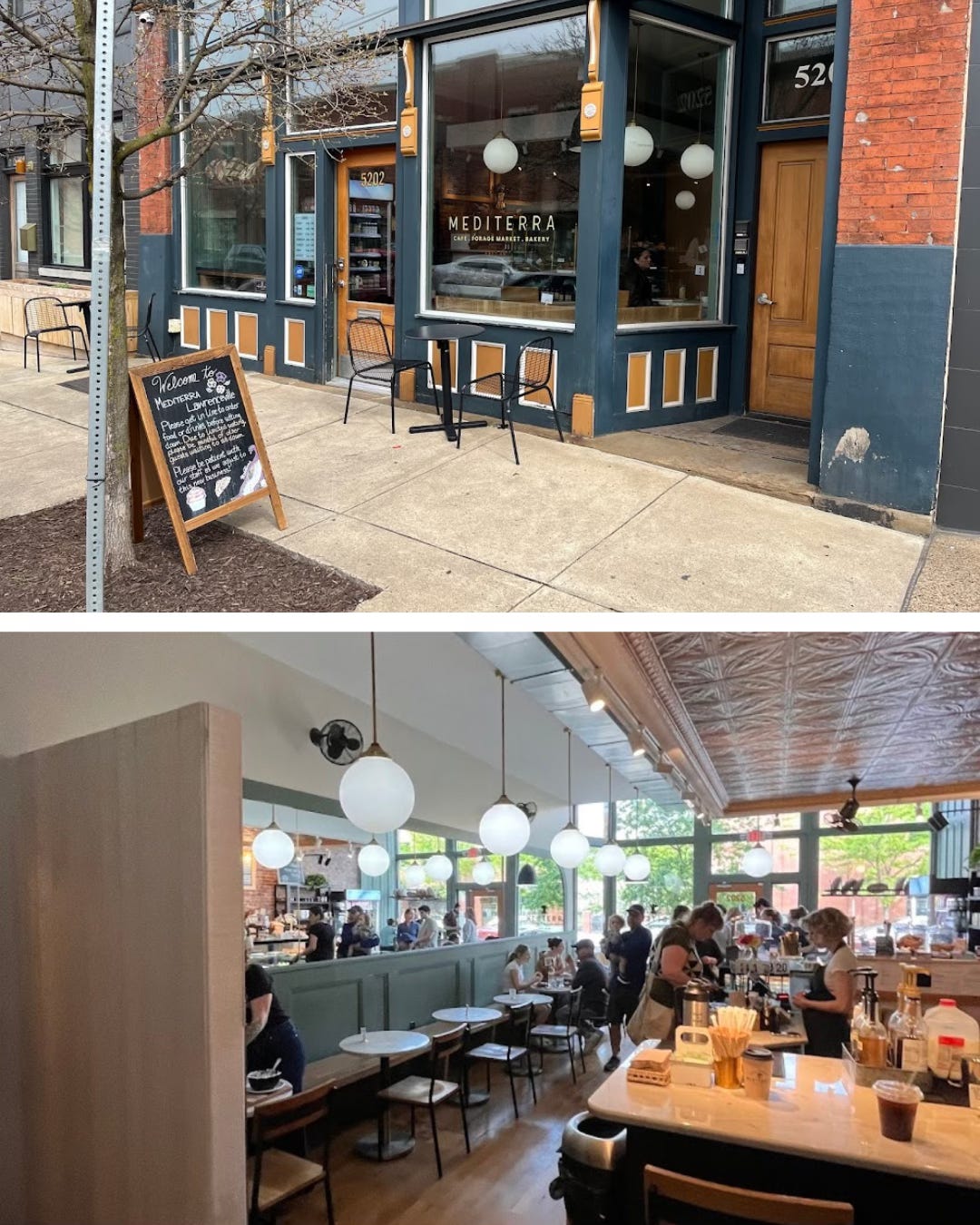
Next, we visited Mediterra, a restaurant with four locations across Pennsylvania. Lawrenceville, one of Pittsburgh’s largest neighborhoods, is known for its historic brick buildings. (Lawrenceville Added To National Register Of Historic Places, 2019) I was glad to stop here for a warm bowl of soup while I was fighting a cold. The space felt much narrower than Commonplace, and there was an L-shaped display case of baked goods near the register. What stood out to me were the notes on every table saying, “Please Place Order Before Taking a Seat.” Normally, I’m unsure whether this would be a problem for me, until a caregiver with two young kids came in while we waited for our food. I started to wonder how these rules would work for her. I don’t think a manager would actually enforce the rule strictly, but let’s play this out:
One caregiver, two kids in a space designed for people to zip in and out of. Though. I noticed that she, like me, saw the signs on the table and debated for a while whether to sit the kids down for a minute. Eventually, they were getting squirmy, and she didn’t have a choice. The kids needed somewhere to land, so she sat them down side by side with all their bags at a narrow circular table designed for two people facing each other, while she waited in line and kept an eye on them (see photo of the space above). This space also held one larger circular booth occupied by two friends, who were having a long chat. The line was nearly out the door; the two friends were slowly making their way out, and the caregiver had made barely any progress. The caregiver sees the friends slowly wrapping up and, before their table is yet cleared, swoops in to ask if she can have the booth as they are leaving.
- Where does my body relax? The small size made it hard to feel at ease here. We arrived a bit early for lunch and had to wait, but there wasn’t really anywhere to stand. We ended up awkwardly standing in the middle of the dining room. Even after we sat down, I never felt fully relaxed in this space.
- Where do I feel managed, rushed, or invisible? I think this social rule placed on every table created a barrier that left me, and maybe the person I observed, feeling like we had to figure out what to do with ourselves by ourselves. Our environments need to work harder to make us feel welcomed. It makes me curious about those with different abilities and how they move through these spaces. If we are expected to travel lightly, what happens if that’s not an option for some? I wonder what accommodations can be made. For example, adding stroller parking near the entrance, providing accessible seating options, or designating a small area for people waiting with young children or multiple bags could go a long way. Simple adjustments, like hooks for coats and bags, or seats with extra space, can help everyone feel more at ease. Even clear signage about these options would make people feel seen and supported.
- Who is this space designed for? This place is meant for people who travel light and want a simple, informal meal. You need to be able to move easily in tight spaces and not carry much with you. As someone from the South, I’m not used to the winter up there. I had a thick scarf, a long coat, boots, and my purse with everything I own. Maybe it’s unusual to carry so much, but I don’t think so.
- Who must work harder to feel safe, seen, or comfortable here? People carrying a lot of things and maybe a human or two.
- Where would a child wait? In this case, the caregiver did what she had to do for a good experience: she let the kids sit and waited in line while keeping an eye on them. It seemed like the only option. Our spaces should support the things we care about and help us trust that our kids are safe. Unless we adopt a culture like Sweden’s, where kids wait outside in strollers, we rely heavily on indoor spaces to keep them safe.
- Gentle Interventions: I think flexible seating would help here. Adding smaller tables in unused areas, tall tables, and more outdoor seating would be great for people who travel light. I also like the idea of long, cafeteria-style tables, like at Taproom Coffee in Kirkwood or Antico Pizza Napoletana in Midtown. These setups make it harder to save seats and encourage people to be more mindful of others, which helps the space work better for everyone.
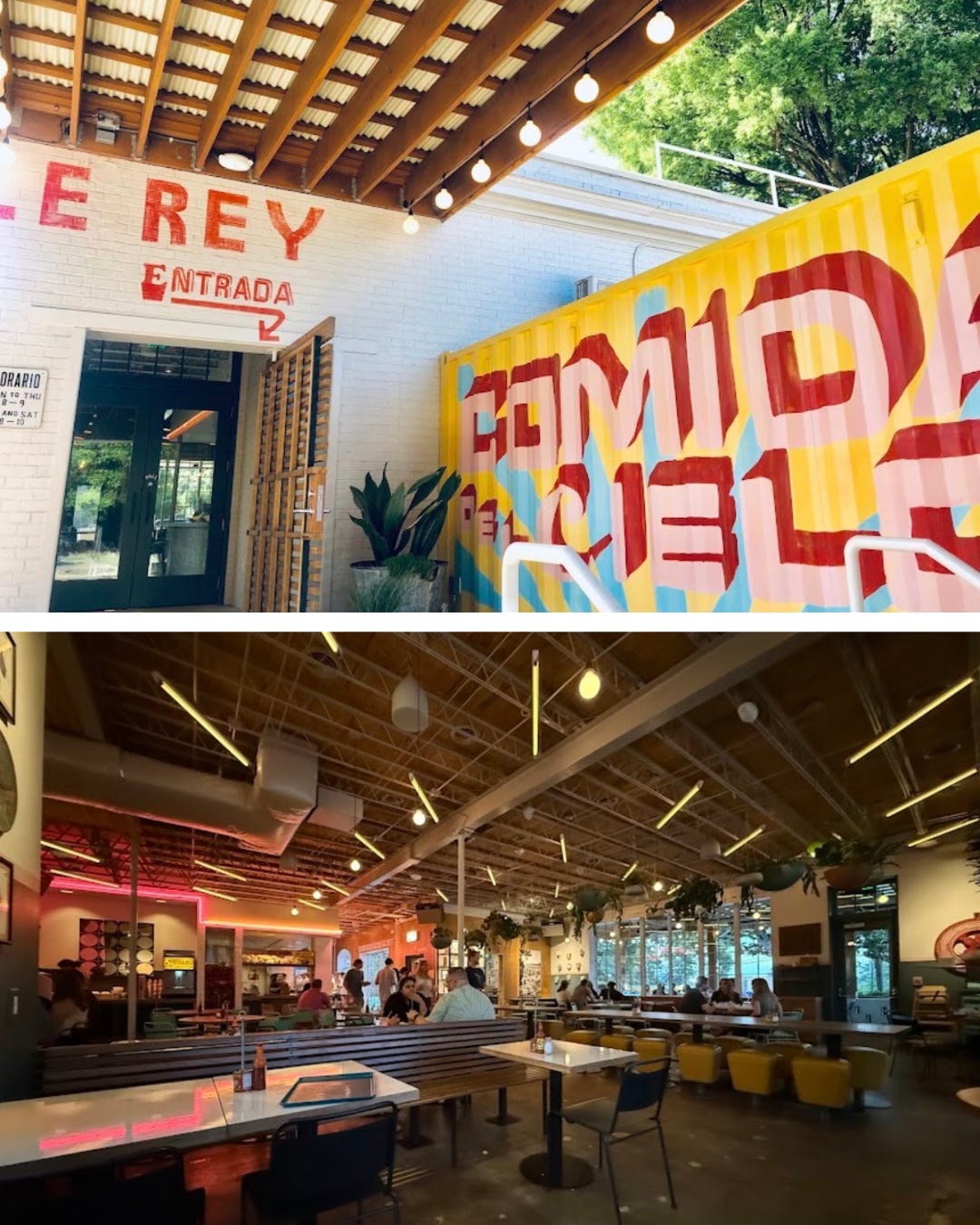
My mom introduced me to Little Rey, a Ford Fry restaurant, last year, and I’ve loved it ever since. It’s the kind of place that’s perfect for Friday nights with friends. If you go, order two chicken quesadillas and a pink margy for me, will ya? Any of the 16 acclaimed Ford Fry restaurants in Atlanta, Houston, and Charlotte has a unique style. Even Ford’s website has its own vibe. Check out the Spotify playlist: https://open.spotify.com/embed/playlist/4y6lhl9nnNiPQtc9Hohymh
I listened to a Spring 2023 episode of the Social Impact Leaders podcast with Ford Fry called “The Menu of Success.” Here are three things I learned:
- The place decides what it wants to be. Existing spaces have their limits, but leaning into their unique features can make them more meaningful. Where we are shapes who we become.
- “We create the table for people to enjoy each other.” Gold! I strongly believe the way a place looks and feels quietly shapes how we act. Thoughtful design can invite people to connect and be creative.
- “It doesn’t have to be overly creative.” Sometimes, less is more. I think about rooms where you’re expected to act a certain way. Can our spaces give us signals, like letting us know it’s okay to relax, like when the lights are dim, and the room feels cozy?
- Who must work harder to feel safe, seen, or comfortable here? This is a Tex-Mex restaurant, but after seeing the cookbook in the dining room, we realized Ford Fry is a white chef who trained in Vermont before moving to Atlanta. Honestly, it made us feel uneasy. Is this cultural appropriation for profit? Does knowing this change how we see the space? If the experience isn’t authentic, is that okay? I think lived experiences and culture matter, but maybe we should pause to consider who is sharing them. The design of a restaurant can either honor the culture it represents by respectfully sharing its history, food traditions, and decor, or it can misrepresent and commercialize it in ways that feel shallow or disconnected. When restaurants adopt elements from a culture, it’s important to consider whether they are telling an authentic story or just borrowing imagery and tastes. Thoughtful design takes care to acknowledge the origins of its influences, uplift the people and communities behind them, and avoid turning culture into a theme for profit. This helps us reflect on how spaces can foster deeper respect and authenticity, not just atmosphere.
- Who lingers? Who passes quickly? This place is made for friends. It works well for big groups, both indoors and outdoors.
- Where might a caregiver feel stress or dignity? I wondered about the bathroom. You need a code to get in, and I didn’t like that because the bathroom isn’t connected to the main dining room and already feels out of the way. It’s also behind big cabana doors, so if you’re not in the long line, you might miss it. I saw a caregiver rush a child to the bathroom, realize there was a keypad, run back inside to get the code, interrupt someone ordering, and hurry back before there was an accident. (By the way, the password is “6767” cue the children in unison) This made me think about how we design access to spaces. As someone who cares about families, it was discouraging to see this barrier. It felt unnecessary and made it clear that not everyone was welcome, even just to use the bathroom.
Reflecting on these visits, it’s clear that restaurant design choices do more than set the mood. They shape who feels welcome, who feels at ease, and how we connect with one another. Every detail, from communal tables to posted rules, signals what kind of community is invited in. As I continue to explore lived spaces, I hope to uncover more ways our environments can foster belonging, comfort, and genuine connection for everyone.
Think back to a recent restaurant, coffee shop, or public space you visited: was there something about its design that shaped how you felt or acted? Did it help you relax and connect, or did it create barriers? I invite you to reflect on how design shaped that experience and on the subtle cues that told you who belongs there.
Next month, I’ll look at three artifacts related to race and class and how our environments are shaped by community.
Resources:
“Commonplace Coffee Mexican War Streets.” Commonplace Coffee, https://commonplacecoffee.com/pages/mexican-war-streets?srsltid=AfmBOorKReReTr5Eh97nEkFHMrRGUAhnDsUB30gYFA5oARyHsXQTYL_9.
Mehran, I. Photo of Commonplace Coffee. Google Maps, https://maps.app.goo.gl/7Dswcrix2gQD1jrq8.
“Lawrenceville Added To National Register Of Historic Places.” National Park Service, 2019, https://www.nps.gov/articles/lawrenceville.htm.
“Mediterra Cafe Lawrenceville.” Wheree, https://mediterra-cafe-lawrenceville.wheree.com.
Lee, Moonyoung. Photo of Mediterra Cafe Lawrenceville.
“Little Rey.” Little Rey Shop, https://littlerey.shop.
Social Impact Leaders. “The Menu of Success.” Featuring Ford Fry, Spring 2023. https://www.socialimpactleaderspodcast.com/episodes/ford-fry-menu-of-success.
 Made for Belonging Studio
Leave a comment