What do Atlanta playgrounds actually teach children about public life? That question has been the thread running through the start of my summer, pushing me to look past the surface and notice how public spaces quietly shape our sense of belonging. My research into the English Avenue School’s possible revival set the stage, but this time, I wanted to see playgrounds through a different lens. One that mixes New Urbanism theory with the messiness of real experience and the evidence I captured on camera. Soon, I’ll be using SketchUp to imagine what a new playground at English Avenue School could look like, but first, I needed to understand what’s already out there.
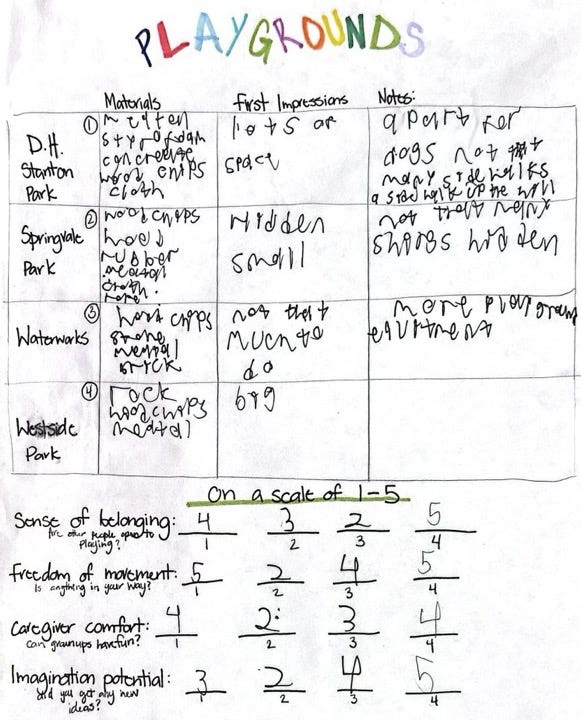
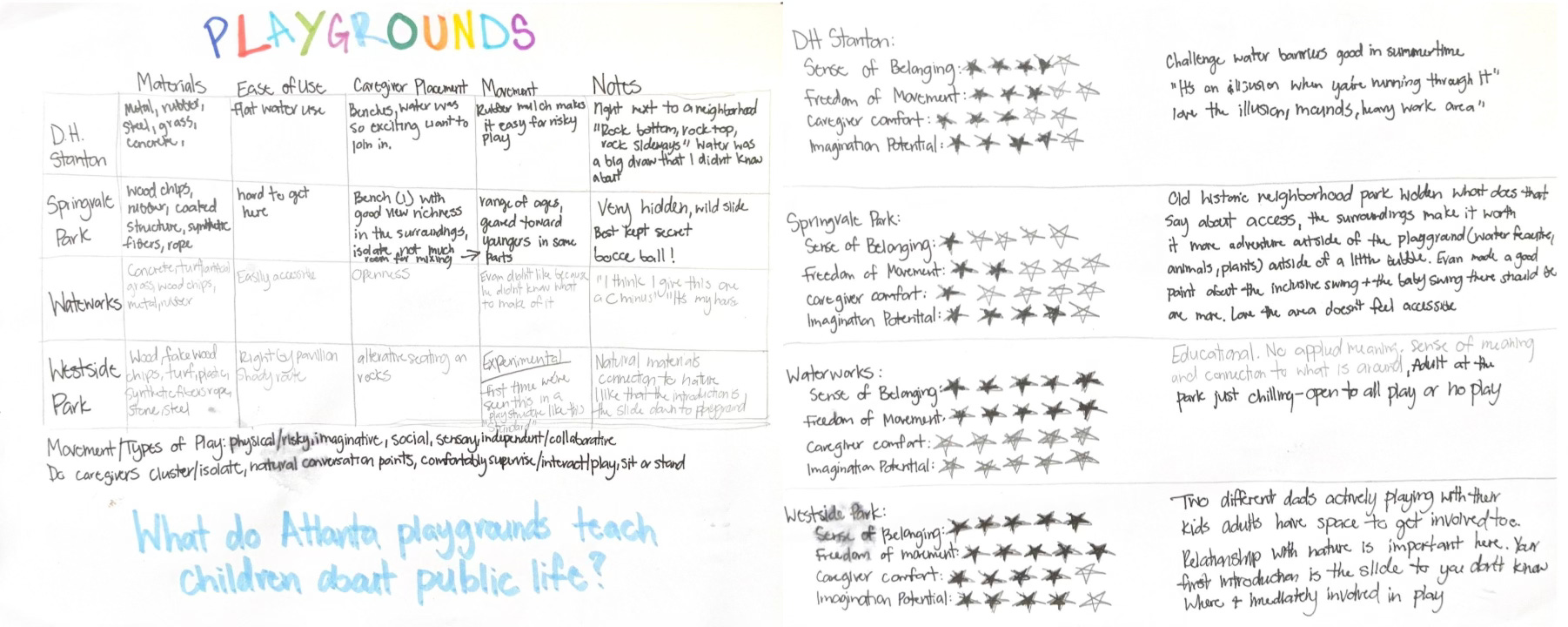
To keep my observations honest, I brought along a rising 5th grader as my research partner. We visited four playgrounds: D.H. Stanton Park, Springvale Park, Waterworks Playscape, and Westside Park. Each picked for its own mix of design, materials, and neighborhood context. At every stop, we used rubrics to track our impressions before and after play, paying close attention to the small details: the feel of the materials, the ways people moved, the subtle barriers, and those in-between spaces where play quietly turns into rest or a moment of connection.
What set this project apart was how much we leaned on both written notes and photos. With a Klik camera in hand, we tried to catch the moments that slip past language—the rush of running through a blue steel tunnel, the way adults and kids negotiate space around a water feature, or the quiet signals in the design that either welcome you in or hold you back. The images and narrative work together to offer a fuller picture of what makes a playground not just a place for children, but a microcosm of public life in Atlanta.
Before we jumped in, my research partner and I took a beat to just watch. We both paid attention to the materials, but my research partner’s first impressions always brought out details I might have missed. After exploring and playing, we’d each fill out a quick post-survey, rating our experience from 1 to 5. I found myself less interested in the obvious stuff and more drawn to how my research partner navigated each space, what pulled him in, and what he ignored. My rubric pushed me to notice the barriers, like where play stopped, where caregivers could hang back or join in, and how people use the space in ways the designers might not have planned.
D.H. Stanton Park (Score 7.5)
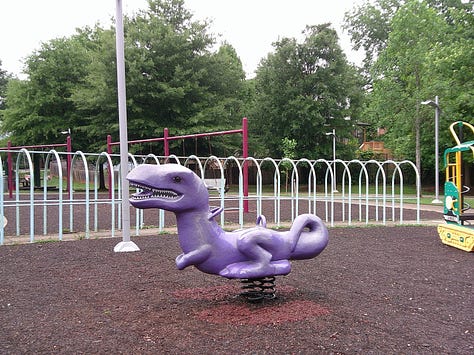
Walking into D.H. Stanton Park, our first park of the day, my research partner and I immediately noticed the colorful mix of materials and structures. In one photo, you can see the bends and curves of a blue-coated steel tunnel appear almost surreal as you run through it. My research partner later described it as “an illusion.” What surprised me most was the water feature at the center of the playground. It’s not like a traditional pool with a shallow and a deep end, but it’s similar to Centennial Park, with a splash pad and fountains. The presence of water reminded me of Hannah Palmer’s book The Pool is Closed, which argues that access to water is a privilege, examines the history of pools, and the challenges faced across the City of Atlanta in accessing water.
The photos above show just how many ways there are to play here: rubber mulch mounds for climbing and rolling, a heavy work area where kids and adults can test their strength, and the surprise of a water feature that draws in everyone. My favorite moment was watching a caregiver with two little kids head straight for the water. The caregiver laughed and played with them, not worried about getting wet, then stepped back to record the moment. That felt like the heart of public life to me.
Our rubric notes tracked how people moved between spaces, and the photos back up my sense that D. H. Stanton Park makes room for both active play and quiet breaks. Caregivers could relax on benches with a clear view of every play zone or jump in and play themselves, a sign that the park was designed with both supervision and participation in mind. Access to water here feels normalized, and having it open year-round makes it feel less exclusive. To me, this part of D.H. Stanton Park tells kids that things once reserved for the elite don’t have to stay that way. It’s a small but real move toward undoing old injustices.
Springvale Park (Score: 4.25)
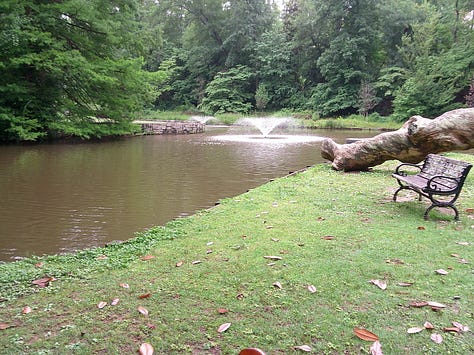
Springvale Park sits tucked away in the middle of Inman Park, hidden deep in the neighborhood’s maze. My research partner led us down a bumpy road past a string of driveways, and after a bit of a trek, we finally spotted the playground behind the trees. For kids who live nearby, it must feel like having a secret spot all to yourself, but as visitors, it felt like we’d stumbled onto something we weren’t meant to find. The real space for imagination and free play was actually outside the playground itself. I loved the old stone stairs leading to the street, the water feature, the wild sea of native plants, and the huge pieces of wood scattered around. The most surprising moment was coming face to face with a Great Blue Heron as we arrived. The real magic was outside the playground’s borders.
Inside the playground, I noticed the Caterpillar Club, a group made up of the City of Atlanta, Park Pride, a few local businesses, and many neighborhood residents. There was also a sign making it clear this playground was for kids ages 5 to 12, not for adults to join in. This space feels like it’s meant for people who already know it’s here. I looked for spots where caregivers might sit and found a stone wall at the back, but the overgrown plants made it tough to picture any adult relaxing there or mingling with other grownups.
If we’re asking what Atlanta playgrounds teach kids about public life, the answer here seems pretty clear: access and privilege still rule. If you don’t know where to look, you might never find it.
Waterworks Playscape (Score: 8.25)
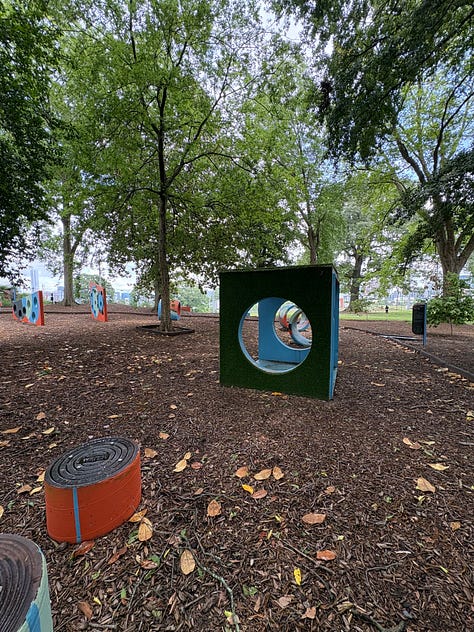
This playscape lays out the story of Atlanta’s drinking water, tracing it from the Chattahoochee River to the tap at home. Built in partnership with the Hemphill Water Treatment Plant across the street, it guides visitors through how water moves through the city. That’s what makes it work for me. Even if you’re new here, you get a sense of what’s happening locally. The space lets you in on the story.
The Waterworks Playscape was my favorite, but my research partner’s least. Right away, he said, “I don’t think we’re going to be here long. There’s not much here.” I watched him compare every playground to D.H. Stanton, probably because it had the classic swings and slides he expected. Waterworks, with its concrete, pipes, and fake grass, didn’t look like a playground to him. The play here isn’t obvious—you have to invent it. After his first reaction, I saw him test the wall with holes, trying to squeeze through, or claim a cube block as his house. He was having fun, even if he couldn’t quite name it, but it was hard for him to compare it to the first park. We climbed, ducked, crawled, and played floor is lava. That’s exactly why I love this place.
It kind of gives you a sneak peek into what goes on in that building every day, the materials that they use, the processes, and the signs that explain each part. Even if you’re new to Atlanta, you can read the signs and suddenly know where you are and what’s happening here. The scenery plays a big role, too. It feels like a place you want to hang out. You have a beautiful view of the Atlanta skyline from an unexpected angle. Waterworks shows kids that public life is built on real resources and behind-the-scenes work most of us never see. There’s a lot of effort, knowledge, and patience holding it all together, and this playground gives you a peek at that hidden machinery.
Westside Park (Score: 9.25)
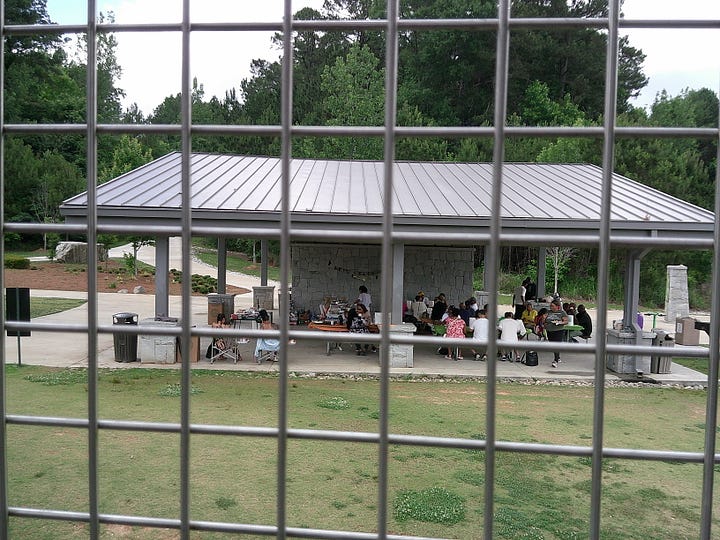
When we got to Westside Park, my research partner found a shortcut to the playground. We climbed a rubber mulch hill, crossed a field, and could either take the slide or run down the hill. Either way, we were there fast. The route itself felt like a quiet nod to accessibility; no matter how you got there, you could get there. I liked the use of natural materials. Moving up and down, let us take in everything from the sky to the wall of kudzu, we were surrounded by the natural world. The playground had nontraditional features: a wooden climbing structure, hammock-like rope swings, and a spinning saucer. We pushed the limits with risky play, seeing how dizzy we could get. I also noticed more caregivers joining in than at any other park. Adults were playing, too. I even took the slide. I wonder if the natural materials made it easier for adults to join in, since the usual shiny plastic wasn’t there to make anyone feel out of place. This park sends a clear message: public life is for everyone.
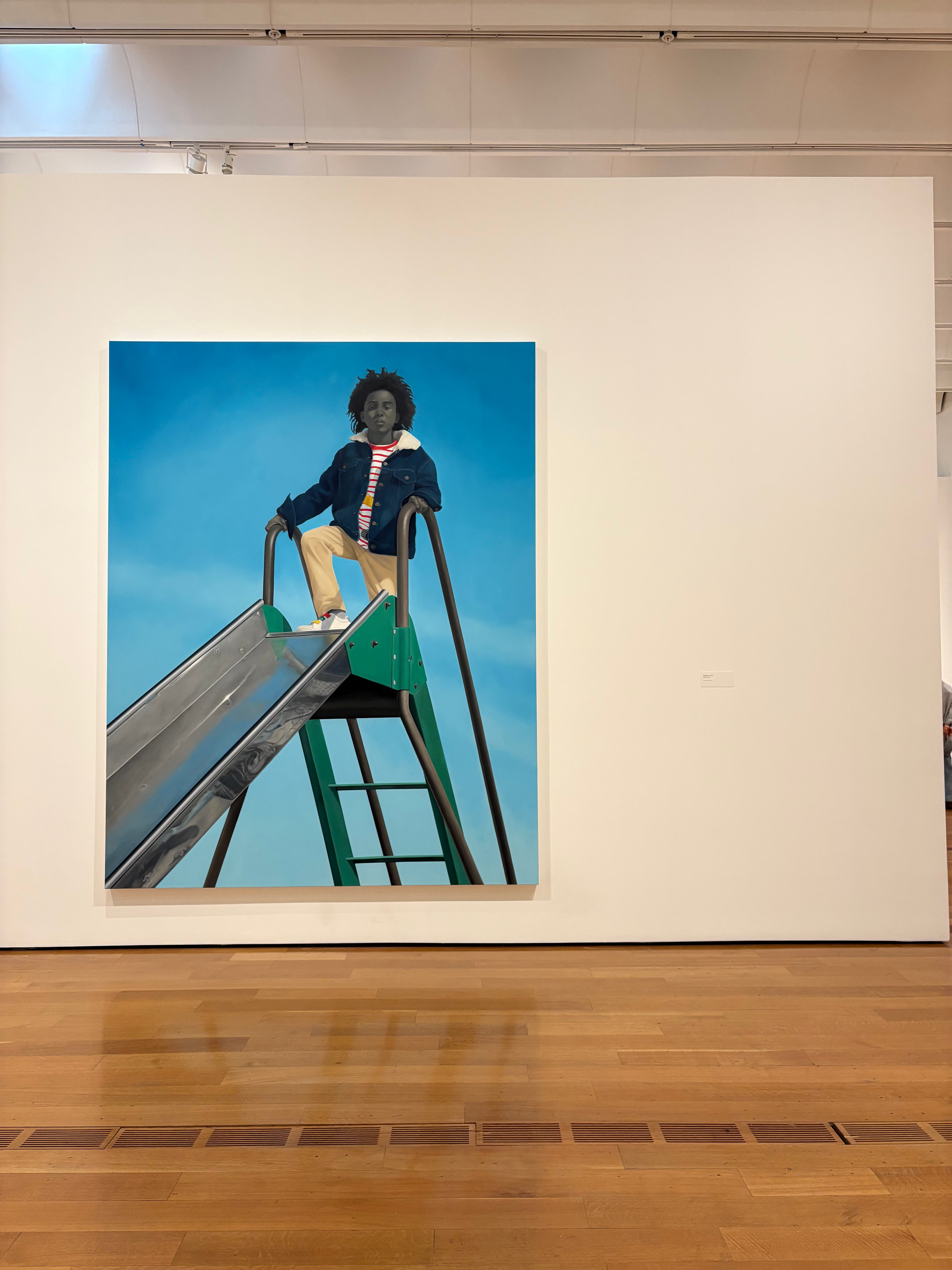
To wrap up, I want to share a photo I took at the High Museum, where I saw Amy Sherald’s American Sublime. Her piece Kingdom, 2022, shows a young Black boy at the top of a slide. What struck me was his look of defiance and confidence, the kind of feeling you only get at the highest point on the playground. I imagine a world where play spaces are open to everyone, regardless of age or ability. I believe our shared spaces can spark real play, imagination, and wonder.
 Made for Belonging Studio
Leave a comment