What do a pool, a flood, and a school have in common? More than you’d think. Through three works, the same question keeps surfacing: who made these decisions, and who was never in the room?
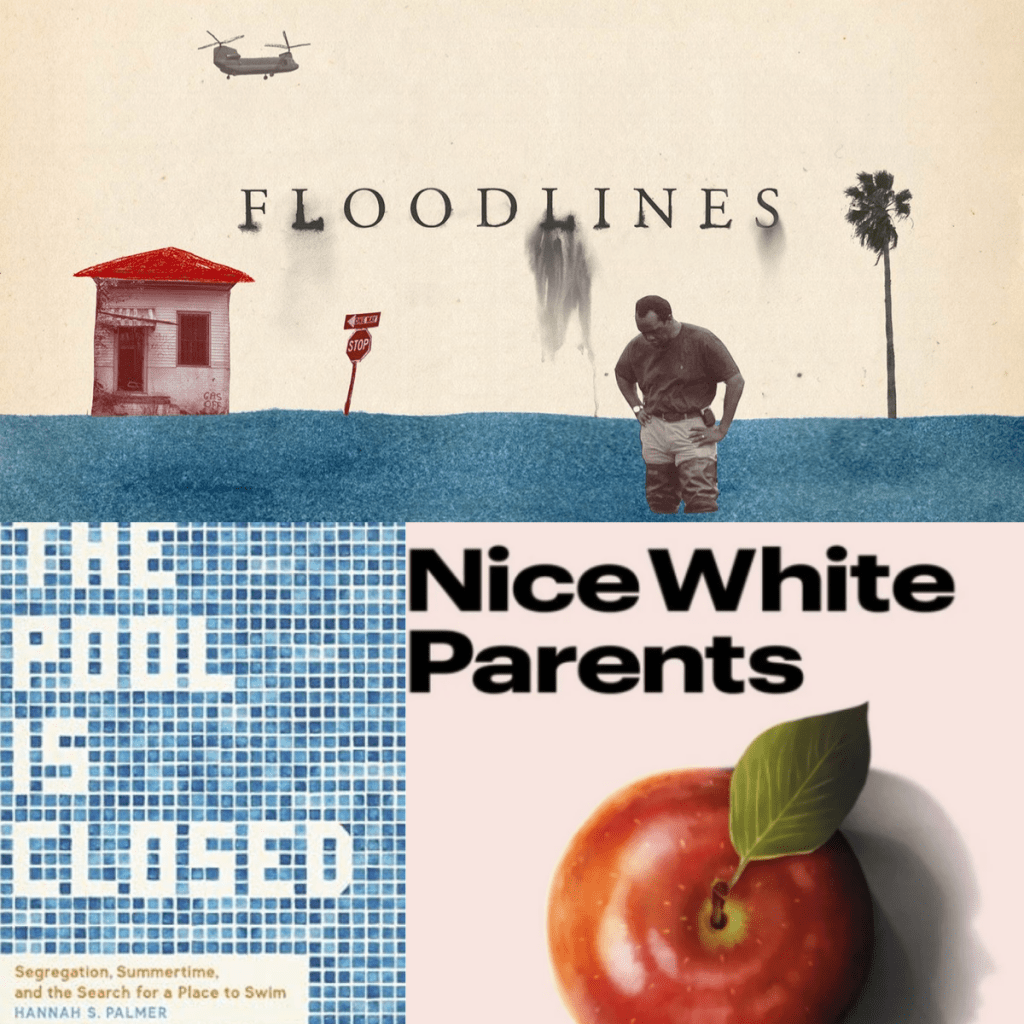
It’s easy to assume that race and class are afterthoughts in how spaces are designed, but the three works I explored this month pushed back pretty hard on that idea. I read The Pool is Closed by Hannah Palmer, listened to the Floodlines podcast from The Atlantic, hosted by Vann R. Newkirk II, and listened to Nice White Parents, from Serial Productions, hosted by Chana Joffe-Walt. Each one made clear, in its own way, that racial bias isn’t a side effect of how our environments are built; it’s often the blueprint.
Floodlines
When things fall apart, communities tend to turn to each other before they turn to the government. I think about the Civil Rights Movement and how local neighborhoods organized sit-ins against businesses that refused to hire Black residents in their neighborhoods. That same spirit of collective resilience runs through Floodlines, which follows what happened to minority communities in New Orleans when the levees broke after Hurricane Katrina. Black and Brown residents were displaced for months, cut off from the people, places, and neighborhoods they knew. One story that stayed with me was Le-Ann Williams, who was 14 at the time. The way she describes losing her home and what it felt like to come back to something that no longer felt like hers is worth sitting with.
I remember pieces of Hurricane Katrina, like my dad with NPR on in the background, listening for updates, and our family trying to reach people back home affected by the storm. But I didn’t understand the politics of it at the time. George W. Bush flew over the damage while families were begging for help on the ground. The levees didn’t just fail; they failed because of years of neglected infrastructure. And the media coverage made things worse, pushing false narratives about looting and violence that targeted Black and Brown residents. What hit me hardest, though, was learning about the mass closure of housing projects. Entire communities were scattered, and many were never given a real chance to come back. Katrina showed, in painful detail, that not everyone gets the same shot at recovery.
Nice White Parents
Community success is built on uneven ground. The people who live somewhere should be the ones shaping its values, its feel, its future, and they should have a real seat at the table when decisions are made. But with hot-button topics like gentrification and redlining, what we see instead is outside money coming in with new, shiny ideas that the community never asked for, and existing residents getting pushed out in the process, along with their assets, their culture, and their sense of place. That’s a big part of why some communities flourish while others quietly die. I’m sitting in a coffee shop in a neighborhood my dad used to call Little Vietnam because of the number of gangs and presence of violence. Now flourishing with human life, independent coffee shops, and bike lanes have appeared. I compare this less than 15-year transformation to a community I still call home in Gresham Park on the East Side of Atlanta, being surrounded by a new Family Dollar opening every day, drive-thru package stores, and too many auto zones to count. Nice White Parents follows the over 60-year history of the New York City public school, Boerum Hill School For International Studies, in Brooklyn’s complex history of segregation throughout the 60s and their current struggles, sharing how parent power often undermines racial integration efforts. This is just one example of how, at the school system level, decisions are made and who is left out of important decision-making opportunities.
This conversation hits home for me. My family is made up of long-time educators, and the fight for equity in the classroom is personal to me. I believe in what a healthy community can do, and these kinds of resources are helping me figure out how to build something that actually invites people in, makes them feel seen, and holds space for them, especially kids and families. Following this community’s experience, when the cycle of white parents’ behaviors spanning decades tries to dominate a school labeled as a “declining school” with a largely black and brown population. This time around, through the introduction of a French language program and significant financial resources, the needs of minority children and families are, yet again, deemed less important than the initiative at hand. Another finding was the introduction of the gifted program, a district-wide initiative intended to make largely minority schools more appealing to white parents while ignoring existing problems. The theme of history repeating itself is one I’m noticing in community building. Essentially, it perpetuates racial inequality within a school system. As demonstrated in the podcast, these shifts often have good intentions that feed into a continuing cycle reshaped with new and fancy language. Not everyone is allowed to win, and depending on where you live, it may be a very long time until real change that benefits the whole community is seen. Throughout this podcast, I kept coming back to the fire I felt for parents and caregivers who didn’t seem to have a voice or meaningful participation when they were up against money, access, and privilege. Frankly, it wasn’t until episode 5 of Nice White Parents, when they shared how the school is making things just and fair for all, that I finally felt a sense of ease. The solution was that parents and caregivers were not allowed to fundraise for the school. This was an agreement among teachers, faculty, staff, caregivers, and vendors that outside fundraising was not allowed, meaning that if one person or group provided resources, those resources were dispensed to everyone. This made me think about the birthday party model in schools. If you invite one kid from the class, you have to invite every kid to make it fair.
The Pool is Closed
Water is political. Space is political. Towards the end of last year, I met author Hannah Palmer at the MLK Recreation and Aquatic Center during a conversation about her book “The Pool is Closed”, hosted by the Atlanta Department of City Planning’s Office of Design. This book begins with the simple problem of Hannah not having access to a community pool in East Point for her kids to swim in over the summer. This problem led her to visit all the pools owned and operated by the City of Atlanta. The conversations span from pools to local creeks and water sources such as the Constitution Lakes, infamously connected to Cop City (within earshot of a community I call home), to the wrought history and present realities of beaches such as Tybee and Jekyll Island. This book does a really thorough job of investigating the complex history of Georgia’s minority residents and water. Access to water is a privilege. I was surprised to learn how many local pools shuttered because their neighborhood communities didn’t want to integrate when segregation became unconstitutional. Places that I know, such as Lake Spivey, a private community once bustling (think mini Disney level), Grant Park’s Lake Abana, now home to the Atlanta Zoo, Piedmont Park’s Lake Clara Meer, all created barriers to entry and even made the choice to fill in their pools once the general public decided that integration was not the way they wanted to go. This is when we see the introduction of private communities, home swimming pools, and paid club memberships rise significantly in our society.
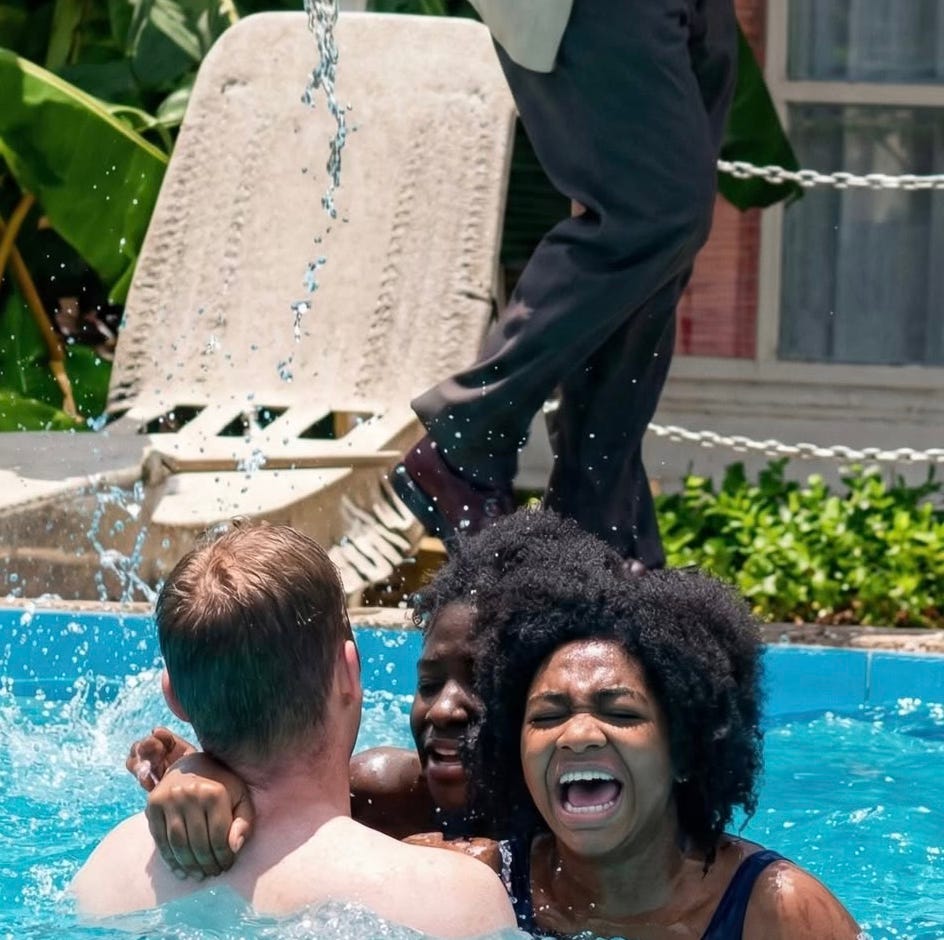
I was scrolling and came across this powerful image shared by @unorthodoxfuture on Instagram. It is a colorised image of an event that took place in 1964 in St. Augustine, Florida, when a hotel manager poured acid in a white-only pool to scare black protestors during a swim-in. Water access is indeed political. This image is powerful in its color because it not only demonstrates the recency of this event but also depicts how race inherently enters spaces and determines who is welcome and if treatment is equal.
Side note: When we moved, we considered joining the local swim club. I wanted to swim, and Hayden wanted to play tennis. We researched a few in our area, and they came with crazy barriers to entry. An application fee to get on the waitlist, an average wait of five years, along with hefty membership dues, and despite all of that, apparently, we don’t meet their zoning preferences, despite being within walking distance. Needless to say, we quit that mission, and it prompted me to think, “Do I even want to be a part of something that intentionally puts up so many barriers to entry?”
I asked Hannah about the how of it all, a loaded question, I know, but I was hungry for something concrete. Her answer was clear: dig into your neighborhood. Know what’s happening in the spaces around you. Understand how decisions get made. And most importantly, show up.
That’s what all three of these works kept coming back to, in different ways. A podcast about floodwaters. A podcast about a school in Brooklyn. A book about swimming pools in Atlanta. On the surface, they don’t have much in common. But underneath, they’re all asking the same question: who gets to belong here, and who decided that?
I don’t have a clean answer. But I’m more convinced than ever that the work starts close to home, in the schools our kids attend, the pools our neighborhoods fill in, and the small businesses that make our communities special. History doesn’t just repeat itself. It gets repackaged. And the only way to interrupt that cycle is to know your ground well enough to notice when it’s shifting beneath you.
Resources:
Joffe-Walt, Chana, host. “Nice White Parents.” Serial Productions and The New York Times, 2020, www.nytimes.com/2020/07/23/podcasts/nice-white-parents-serial.html.
Newkirk, Vann R., II, host. “Floodlines.” The Atlantic, 2020, www.theatlantic.com/podcasts/floodlines/.
Palmer, Hannah S. The Pool Is Closed: Segregation, Summertime, and the Search for a Place to Swim. Louisiana State University Press, 2024.
 Made for Belonging Studio
Leave a comment