One particular school, its complex history, its present, and a dream for the future.

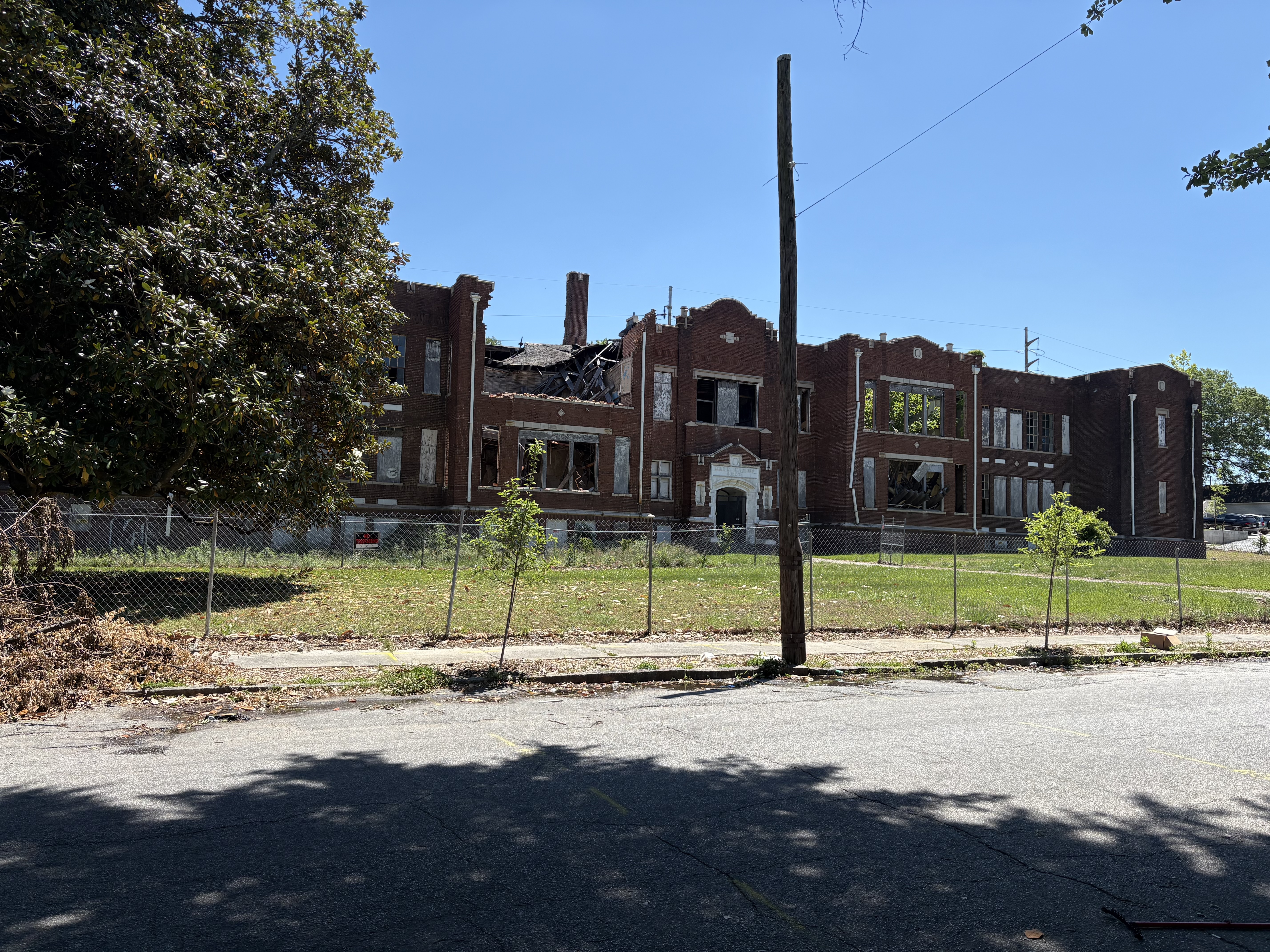
This month, I’ve been thinking a lot about how to protect community assets while supporting the basic needs of working families and considering what shapes a community’s identity. The English Avenue School, built in 1911, started as an all-White day school. In the 1950s, the Board of Education reassigned it as a segregated all-Black day school. In December 1960, 2,000 local residents gathered in its auditorium to pray before protesting segregation. The next day, the school was bombed, which was a painful moment for the neighborhood. Archive Atlanta reported that it was called “the worst racially-motivated bombings in the City of Atlanta.” Today, the building looks much as it did in 1960 and was officially closed by the city in 1995. You can see where the ceiling has collapsed, and the facade is falling apart. It’s a clear sign of Atlanta’s complicated history.
Here’s a look at the English Avenue School over the years, from 2007 to 2025:


Two years ago, I walked with my church to the old English Avenue School, and I still think about that place often. It’s heartbreaking in the punchiest way possible. The atmosphere feels different, and even without knowing its history, there’s a strong energy that lingers. It’s sad because the building’s structure is beautiful, and what once stood here was beautiful too. The building’s current state shows how much time has passed and how uncertain its future is. Looking at photos from the past 20 years made me reflect on my own life and how much this community has changed during that time. Most importantly, I still wonder what messages this building sends to the community’s residents every day. Do they feel forgotten? Left behind amidst all of the drastic “progress” forward within the last decade? Does it hurt? Does it even matter?

The school is located between the Georgia Institute of Technology campus (established in 1885), the Fulton County Jail (built between 1985-89), and the Mercedes-Benz Stadium built between (2014-17). Atlanta has become a cultural center for the South, and the stadium has brought new opportunities for sports and entertainment. Teams like Atlanta United now have a home there, and the stadium hosts events like the World Cup, concerts by major artists (I’ve seen Beyoncé here twice; she loves Atlanta), and is set to host the 2028 Super Bowl, according to their website. With the stadium bringing new energy and business to the area, here’s what else has been happening in the neighborhood:
- The old, currently abandoned St. Mark African Methodist Episcopal Church, which left the neighborhood in 1976, left behind a beautiful stone skeleton. Learn more about their history and the building here.
- Mattie Freeland Park est 2008 (612 Echo St NW, Atlanta, GA 30318).
- Mattie Freeland Community House est 2008 (707 Dalvigney St NW, Atlanta, GA 30318).
- Ms. Mattie Freeland used to look out her window at a lot cluttered with abandoned cars, a daily reminder of what people thought this neighborhood was worth. After she passed in 2008, her neighbors, together with New Life Covenant Church, the Arthur M. Blank Family Foundation, and the same construction giants behind the Mercedes-Benz Stadium, stepped in to reclaim the space. What was once a dumping ground is now a community center and green space, a living tribute to Ms. Mattie’s stubborn hope for her block.
- PeopleReady – Industrial Staffing Agency (this space has always been a workforce opportunity building) est. 2017 (670 Northside Dr NW, Atlanta, GA 30318).
- The Mercedes-Benz Stadium est 2017 (1 AMB Dr NW, Atlanta, GA 30313).
- The Trap Music Museum est. 2018 (630 Travis St NW, Atlanta, GA 30318).
- Westside Early Learning Family Childcare est. 2022 (701 North Ave NW, Atlanta, GA 30318) an essential partner that I would involve in this project.
- The Westside Motor Lounge est. 2022 (725 Echo St NW, Atlanta, GA 30318).
Follow me back to the school.

The school officially closed its doors in 1995. In 2010, the Greater Vine City Opportunities Program bought the building, hoping to turn it into a community center, but it looks like funding—or the lack of it—stopped that plan in its tracks. By 2020, the building landed on the National Register of Historic Places. Then came a $30 million adaptive reuse plan that got the City Council’s green light in 2021. In 2022, the Atlanta Preservation Center picked up a $500,000 National Park Service grant for emergency stabilization and a historic structures report. Since then, though, it’s been mostly radio silence.
It’s easy to fall into the trap of “if they wanted to, they would.” If bringing the community along for the ride was really a priority, wouldn’t we see more than just plans and press releases? There’s energy, there’s excitement, there’s even some money, but the building is still just sitting there. That inertia says more about how we value this neighborhood than any official statement ever could.
For this project, I’m stepping into the developer’s shoes, trying to imagine what it would look like to actually flip a space so it works for the people who live here. Developers aren’t just supposed to provide four walls; they’re supposed to create access, safety, and the conditions for something real to grow. I’ve been digging into zoning laws, trying to figure out if the ideas I have could actually work if the right people got involved. I spent April looking at services that meet basic needs, and what struck me is how hard it is for working families to find a single place that covers the essentials without having to crisscross the city. So I started sketching out the kind of space I wish existed. I admittedly don’t have all the answers, but I know this: it’s going to take real partnership with people who know what they’re doing. English Avenue already has organizing and community partners who care. What if we actually brought those assets together, right here?


Here’s my pitch: let’s give this space a new purpose. The idea of a community center was on the right track, but leaving it as a blank slate puts too much onus and pressure on residents to conjure up the magic themselves. What if, instead, we built a collective services hub with community care at its core, something that actually advocates for the neighborhood, the way Ms. Mattie Freeland did? When I dug into the zoning codes, I found out English Avenue is a Special Public Interest District, which means it’s supposed to be protected and enhanced for its unique character. So why not fill this building with things people actually need: indoor showers and bathrooms, a library, a mixed-use farmers market, studios for artists, a preschool with a state-of-the-art playground, a courtyard tended by seniors, and a laundromat?
I took a stab at understanding principal and accessory uses and special permits and found the following for each of my ideas for 627 English Avenue NW:
Indoor showers and bathrooms: Personal care homes require a special use permit, which may make it difficult to find a company in this space that can properly oversee the installation and maintenance of these spaces. This is a radical idea: to provide dignity and care to those looking to meet their basic needs. I believe that with the proper trust-building “surveillance,” this is possible.
Library: Museums, Galleries, Auditoriums, Libraries & similar Cultural facilities are not permitted. Heartbreaking! The rebel in me tried to think of ways to make this possible. What if we found someone who operated under an interlibrary loan model like Solange’s Saint Heron Library and also held programming? Well, then that would make it a different kind of place that uplifts the community and celebrates books (right?)!
Indoor/Outdoor Farmers Market: Permitted (with some considerations)! Access to healthy foods is a great way to ensure children and families have what they need to thrive. I’m glad we could outfit something like that here.
Artist in Residence Studios: Prohibited…booo!!! But again, what if we called them something else?
Preschool with an outfitted playground: Permitted
Courtyard: In partnership with a local senior center is designed to promote connection with nature and neighbors.
Laundromat: Laundry & dry cleaning & Collection Stations are allowed, but no more than 5,000 sf. I think we could make this happen with the right setup.
On my honeymoon in Vancouver, I picked up Good Services: Decoding the Mystery of What Makes a Good Service Book by Lou Downe from Nooroongji Books (my new favorite place) because I wanted to figure out how to build something that actually works for people. The biggest lesson? You have to be crystal clear about what your service does—and what it doesn’t. If you miss that, people end up frustrated and lost, stuck in a loop of confusion because the system was never set up to help them succeed. The book also drives home the need to map out exactly how someone moves from point A to point B. I’ve seen nonprofits struggle with this: when you try to do everything, you end up doing nothing well. It’s not just exhausting; it actually pushes people away. The same logic applies to any system you build. Some things need to stay consistent to avoid chaos, but if you’re going to change things up, you have to communicate the process clearly and keep repeating it until it sticks.
In Conclusion
Frank Fernandez President and CEO of the Community Foundation of Greater Atlanta said, “Where you live dictates what kind of life choices you’ll experience, such as access to healthcare, where your kids go to school, how you feel walking down the street,” and the Katie Kirkpatrick President and CEO of Atlanta Chamber of Commerce said, “We have a disconnected region with space that’s being underutilized.”
All of these point to a real opportunity for growth. Change isn’t just possible, it’s necessary. We owe it to each other to create spaces that actually serve, uplift, and support the people who call this place home.
I talked with Daryl, a veteran who lives in English Avenue, and what stuck with me was how our conversation kept coming back to one thing: humanity. Just seeing each other as people. The building itself says a lot without ever speaking, and that’s why I keep coming back to the idea of calling this reimagined space The Human Center. It’s a reminder that everyone’s story matters, that meeting basic needs is non-negotiable, and that our spaces are where our humanness lives. Wholeness isn’t out of reach. It just takes a neighbor willing to help.
Resources:
- “Code of Ordinances: Chapter 16-18 – Special Public Interest Districts.” Municode Library, City of Atlanta, https://library.municode.com/ga/atlanta/codes/code_of_ordinances?nodeId=PTIIICOORANDECO_PT16ZO_CH16-18CSENAVSPPUINDI.
- “Zoning Map.” Atlanta GIS, City of Atlanta, https://gis.atlantaga.gov/zoningmap/.
Leave a comment